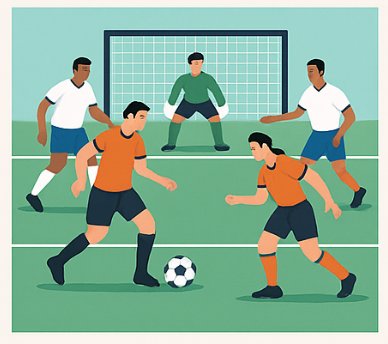
Business leaders have used the metaphor of a soccer team for decades to describe how a company should function. This metaphor is a set of players with different roles working toward a common goal coordinated by a coach manager working to win the game within a set of rules and a defined field. This metaphor worked well in stable environments with hierarchies, fixed roles, aligned objectives, and long planning cycles. But in today’s world, global companies must function in a VUCA environment.
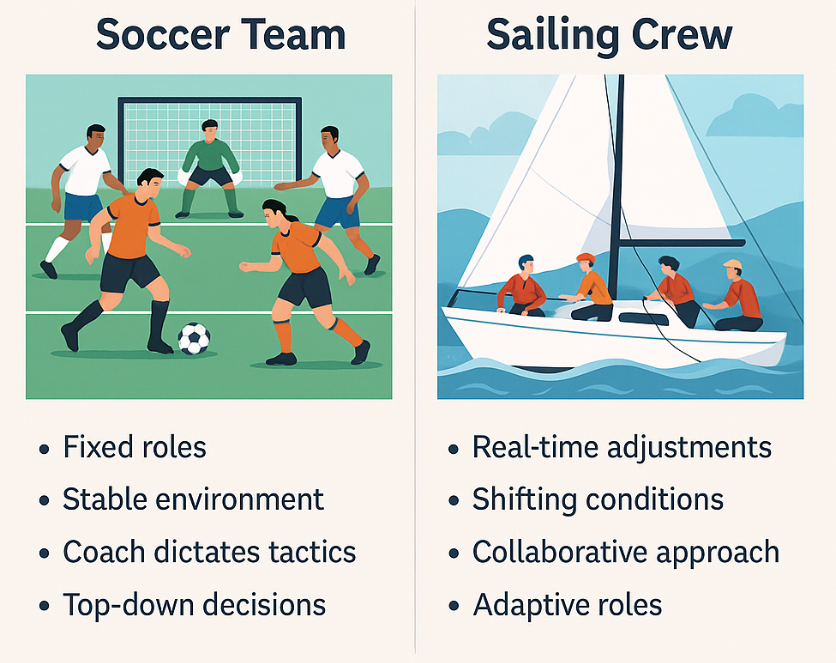
The “soccer team” metaphor assumes the following:
- stable, unchanging conditions, where roles and responsibilities remain constant over time;
- a bounded field of play with fixed and well-known rules;
- a singular, supreme authority (coach or manager) setting strategy and tactics;
- coordinated actions with predictable cycles of interdependence.
In a VUCA environment, the fixed, role-based, predict-and-execute structure of a soccer team is fundamentally flawed.
Modern international companies are required to rapidly and continuously adapt to different regulatory, economic, technological, geopolitical, or supply-chain shocks.
Above reported assumptions ultimately prevent us from adapting and responding to change.
Today, the challenges of modern organizations highlight the need for collaborative efforts.
Organizations today require multidisciplinary teams more than ever.
The modern and more suitable metaphor
Sailing metaphors illustrate the importance of having a captain and a ship’s crew where the captain sets the course, and the crew have to make multiple adjustments to the sails based on volatile external conditions.
Setbacks like the current economic climate and disruptions to supply chains, regulatory policies, and new technologies require organizations to have the adaptability and agility akin to the sailing crew in the above metaphor. In the sailing crew metaphor, the captain and the crew serve different yet equally important functions where the captain serves the important purpose of setting the long-term vision and direction for the organization, while the crew incorporate real time, cross sectional collaboration to adjust and adapt to changes in the external environment.
In the analogy and in real life, success is based on adaptability to the external environment. This is done with plans, but these plans cannot be rigid; rather they need to be achieved in real time based on the feedback the organization receives based on the external conditions and the crew’s situational awareness.
Indeed, advocates of concepts such as Agile leadership stress the importance of adaptive, self-managing teams that can react to changing situations without delay.
Smaller, more autonomous teams tend to:
- make decisions faster, owing to fewer communication channels and less coordination overhead;
- pivot quickly when the situation requires (i.e. market demand, supply chain, and regulations);
- foster engagement and motivation as team members are more empowered, accountable, and sense ownership;;
- cut down on excessive bureaucracy and “decision-making bottlenecks,” thus increasing transparency and clarity.
For a multinational company spanning across regulatory frameworks, jurisdictions, geographies, cultures, and technical domains (like a shipyard company or a factory industrial group), such qualities are not optional. They are very crucial.
What this implies for leadership and organization design.
This metaphorically means that if you build a soccer team, you will construct a functionally siloed, highly bureaucratic, superficial output (quarterly/annual plans), and have roles that are locked. However, if you build a sailing crew or proactive pod, you will design for continuing cross-functionality, rapid feedback loops, decentralized iterative decision-making, and perpetual evolutionary growth.
Leaders need to position the purpose and the direction, then leave it to the teams to decide with enterèrenurial approach the tactics as the situation dictates.
The organization has to be to build and embrace complexity. The business landscape is fundamentally disordered. This metaphor sailing/swarming and chaos/complexity should help build intangible cultures that are able to optimize chaos rather than attempt to control it rigidly.
In the context of these intricacies, the soccer analogy lies at the furthest extreme from reality, as it attempts a crude approximation of the intricacies of the global, complex, rapidly evolving reality of the contemporary business world. It assumes the coordination of a great deal of energy under a set of rules, but misses the fluidity, the need for constant rapid decision-making, and the constant need to adapt to new challenges.
In stark contrast, metaphors from the world of sailing, with the need to adapt to a restively changing environment, seamless integration with it, and cooperative and responsive to the environment team synergy, and the world of small swarming teams characterized by fast decision-making, bounded autonomy, rapid iteration, and disruptive innovation, are apt for global organizations.
Selected References
“VUCA Leadership Model,” Potential Unearthed, 2017. potentialunearthed.co.uk+1
“Team Metaphors: From SWAT Teams to SWARM Teams,” JD Meier, 2024. JD Meier
“Why Smaller Scrum Teams Deliver a Bigger Impact,” Scrum.org, 2025. Scrum.org+1
“Small teams are the lifeblood of a successful, agile corporation,” McKinsey – Unleashing the power of small, independent teams. McKinsey & Company
Wu, L., Wang, D., & Evans, J. “Large Teams Have Developed Science and Technology; Small Teams Have Disrupted It,” arXiv preprint, 2017. arXiv
Why Metaphors Matter in Leadership Storytelling,” LeadershipStoryBank, 2025.