In project-based industries—construction, engineering, infrastructure—Kaizen often gets dismissed before it’s even understood.
Ironically, the environments that need continuous improvement the most are often the ones that resist it the hardest.
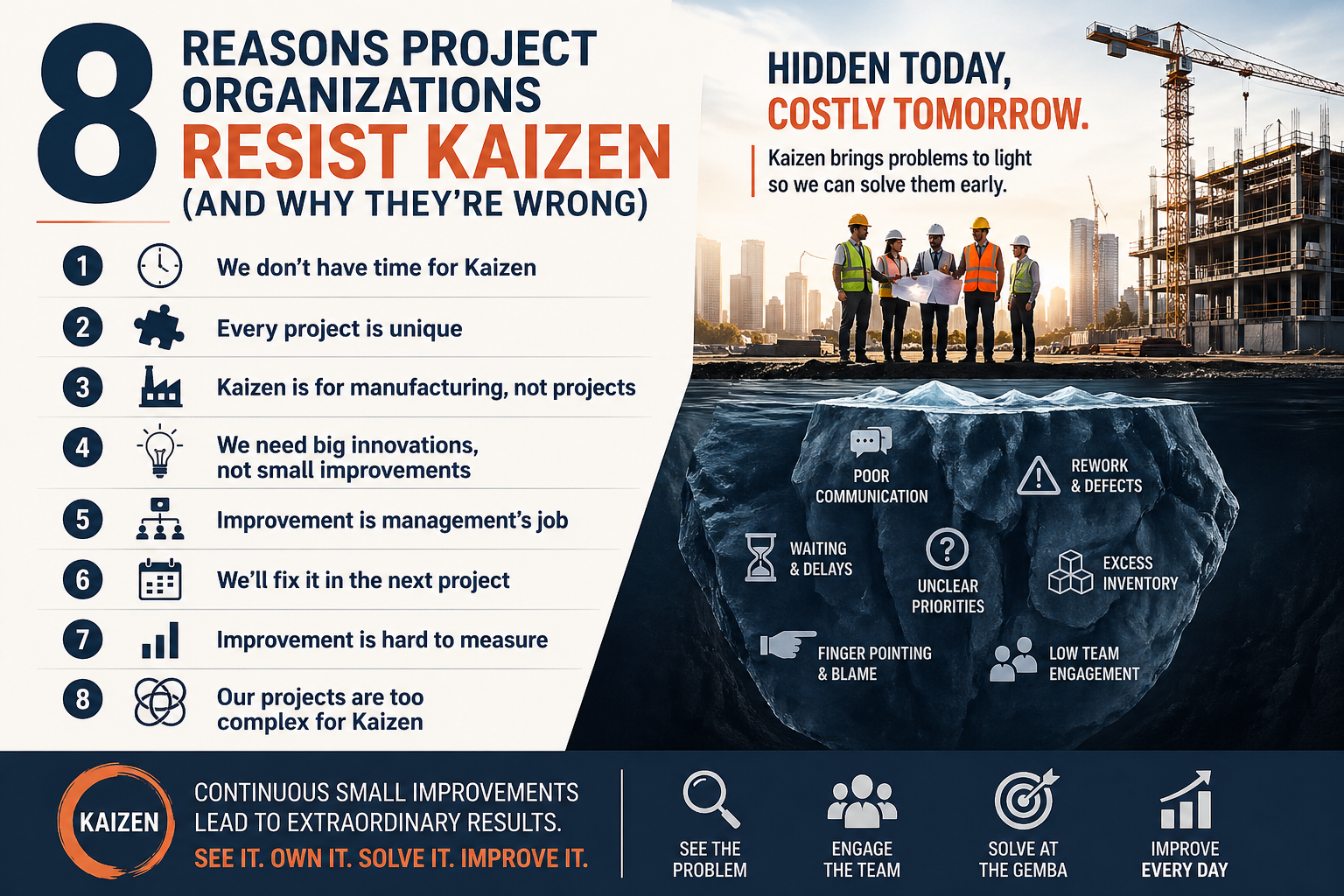
1. “We don’t have time for Kaizen”
Projects are deadline-driven. When schedules slip, the instinct is to push harder, not to stop and improve.
But the truth is that:
Most project delays are not caused by lack of effort, they’re caused by waste.
Waiting, rework, poor coordination, unclear scope: these consume more time than any improvement activity ever will.
Kaizen doesn’t compete with delivery. It enables it.
2. “Every project is unique”
Yes, every project has unique characteristics: location, stakeholders, constraints.
But the processes behind delivery are highly repetitive:
- Planning
- Procurement
- Coordination
- Issue resolution
Kaizen doesn’t standardize the product, it stabilizes the process. Without that, every project becomes a reinvention exercise.
3. “Kaizen is for manufacturing, not projects”
This is one of the most persistent myths Lean thinking was born in manufacturing, especially in automotive where the margins where extremely low. Project-based organizations in the past could rely on much bigger margins and the waste could even be tollerated.
The waste exists everywhere, the level of tolerance today is different also in project-based business.
- Waiting for approvals
- Rework due to poor information
- Overprocessing in reporting
- Inefficient handoffs
Project environments are often less controlled than factories, which makes waste even more present and costly.
4. “We need big innovations, not small improvements”
Project cultures tend to favor breakthroughs: new tools, new systems, major transformations.
But most performance gains don’t come from big ideas. They come from fixing everyday inefficiencies.
Kaizen works because it compounds:
Small improvements × many people × every day = significant impact
5. “Improvement is management’s job”
Traditional project structures separate thinking from doing.
But the people closest to the work:
- See the problems first
- Understand the constraints best
- Know what actually works
Kaizen shifts improvement from a top-down initiative to a team capability. Without that shift, improvement stays theoretical.
6. “We’ll fix it in the next project”
This is where organizations quietly accept waste.
Lessons learned are documented… and then ignored. Somebody even considers that documenting the lessons learnt is a waste.
The same problems reappear:
- Coordination breakdowns
- Design issues
- Delayed decisions
Kaizen flips this mindset:
Improve now, where the work is happening.
Because “next project” usually means “same problem, different project.”
7. “Improvement is hard to measure”
Project KPIs are clear:
- Time
- Cost
- Quality
What’s often missed is that Kaizen directly impacts all three:
- Reduced rework → lower cost
- Better flow → shorter schedules
- Fewer errors → higher quality
If improvement isn’t visible, it’s usually because it’s not being tracked—not because it isn’t happening.
8. “Our projects are too complex for Kaizen”
Complexity is often used as a reason to avoid change.
In reality, it’s the strongest argument for it.
Projects involve:
- Multiple stakeholders
- Interdependencies
- Constant change
Without continuous improvement, complexity turns into chaos. Kaizen brings structure, visibility, and learning into that complexity.
The Real Issue Isn’t Kaizen, It’s the System
These criticisms point to deeper challenges:
- Firefighting culture
- Lack of standard processes
- Weak feedback loops
- Limited team engagement
Kaizen doesn’t just improve processes, it exposes these systemic issues. And that’s where the discomfort comes from.
Kaizen in highly politicized organizations.
When careers, reputation, and power are at stake, people quickly learn that exposing issues is risky. So instead of solving problems, the system rewards hiding them, softening them, or pushing them downstream.
The result?
- Issues surface late, when they’re more expensive
- “Green” reports mask red realities
- Teams spend more energy managing perception than improving performance
From a Kaizen perspective, this is the opposite of what’s needed.
Continuous improvement depends on one critical condition: problems must be visible, early, and without fear.
If people feel safer hiding issues than raising them, no tool, method, or transformation will work.
In highly politicized environments, the real work isn’t process improvement, it’s creating psychological safety and shifting what the organization rewards.